Service Tel:


 Home
Home  News
NewsCaCO₃ is the most important and most consumed mineral in the plastic industry, applicable to various fields.
Time: 2026-06-26
CaCO3 is the most important mineral in the plastic industry and also the largest consumer of minerals, which can be applied to a variety of fields.
First, Calcium carbonate (CaCO3) is one of the most commonly used mineral modifiers
An advanced blown film extrusion line is capable of processing a variety of raw materials, and in general, these resins can be used as pellets, which can be generated in the reactor or mixed with additives in a second stage before being fed into the converter. Film manufacturers blend these resins, additives, and masterbatch to produce a variety of blown films up to11 layers. Mineral modifiers provide the opportunity for the economic production of films. At the same time, the mechanical properties of polyolefin films are also improved, and the thickness is greatly reduced. Among them,calcium carbonate (CaCO3)) is one of the most commonly used mineral modifiers.
.png)
Second,CaCO3 powder can be directly added to the film blowing processing line
CaCO3 is normally added to polyolefins in the form of a masterbatch. However, some special production lines can directly add CaCO3 powder into the production process of pipes and polypropylene sheet. The manufacturers have now managed to directly add CaCO3 powder into the processing line of blown film. These integrated super-blended technology production lines are equipped with a specialco-rotating twin screw extruder and are designed as single layer lines or three-layer lines equipped with two standard extruders for producing ultra-thin surface layers.
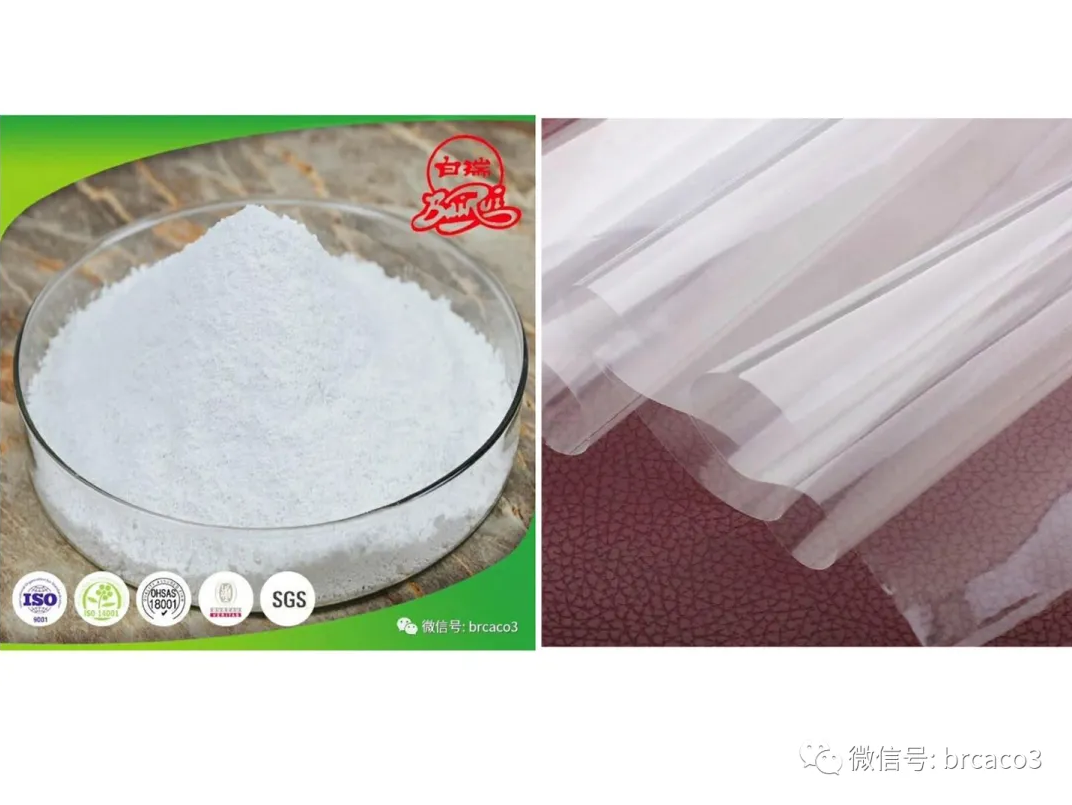
Third, The advantages of CaCO3 used in blow molding film
It is worth noting that the selection of the right type of CaCO3 powder is the premise of obtaining excellent performance in plastic applications, the right specific particle size distribution, high purity and optimized surface treatment.
1.Why is CaCO3 suitable for blow molding film?
Besides its antistatic properties, calcium carbonate has a variety of other properties, and it can also modify the physical properties of polymer melts. Compared to unfilled polyolefins,CaCO3 has a higher density, thermal conductivity, and lower heat capacity, and it can maintain a solid form during the extrusion process. The main characteristics obtained from this are:
● Increase the output of the extruder
● Reduce melt pressure and extruder torque
● Improve efficiency and accelerate the cooling speed of the membrane bubble
● Homogenization of the melt
To sum up, addingCaCO3 to the blown film production line is a simple and effective way to improve production efficiency and output.
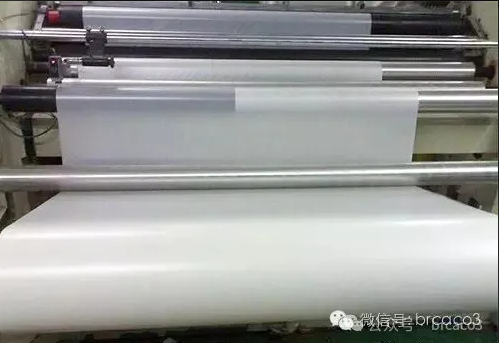
2. The benefits of adding CaCO3 to blown film
(1) Improving film performance
Adding fine surface-treated CaCO3 to the semi-crystalline polymer matrix improves the performance of blow-molded films, such as:
● Increase stiffness
● Improve the impact resistance of the hammer
● Anti-adhesion effect
● Improved tear resistance (Elmendorf)
● Improve barrier performance
● Slightly increase surface tension
● Unstretched: Increase film density
● Stretching: reduce density, and sometimes also the permeation effect
The magnitude of the changes in the properties of the above polymers is to a large extent determined by the composition of the film, the thickness of the film, the mineral content, andthe type of CaCO3.
Successful applications of CaCO3 in blow-moulded films include shopping bags, vest bags, bin bags, paper-like films, agricultural films, heavy-duty packaging bags and back-vent films.
(2) Reduce formula cost
The addition of CaCO3 increased the film density, so it was necessary to reduce the film thickness to maintain a constant film weight, what is known as down-gauging. It is worth noting that this growth is not linearly related to the mineral content. For example, a CaCO3 content of 30% only requires a 20% reduction in film thickness to maintain a constant film weight.
(3)Improve sustainability
The entire process chain also saves energy. By mixingCaCO3 powder, the super-homogenization technology also provides higher sustainability. The process saves thermal energy during the extrusion process, as these minerals have a significantly lower specific heat than polymers. From this result, the technology is able to significantly reduce the carbon footprint and environmental impact of the product.
(4) Advantages of direct feeding
The direct addition of CaCO3 can save a significant amount of raw material costs, and its cost-saving potential can be seen in Figure 3, which is based on a polymer price of about 1100 €/ton.
.png)
Furthermore, in cases where under-metering is not feasible,the direct extrusion of CaCO3 still has the potential to save costs and improve mechanical properties through the reinforcement effect of the mineral.